



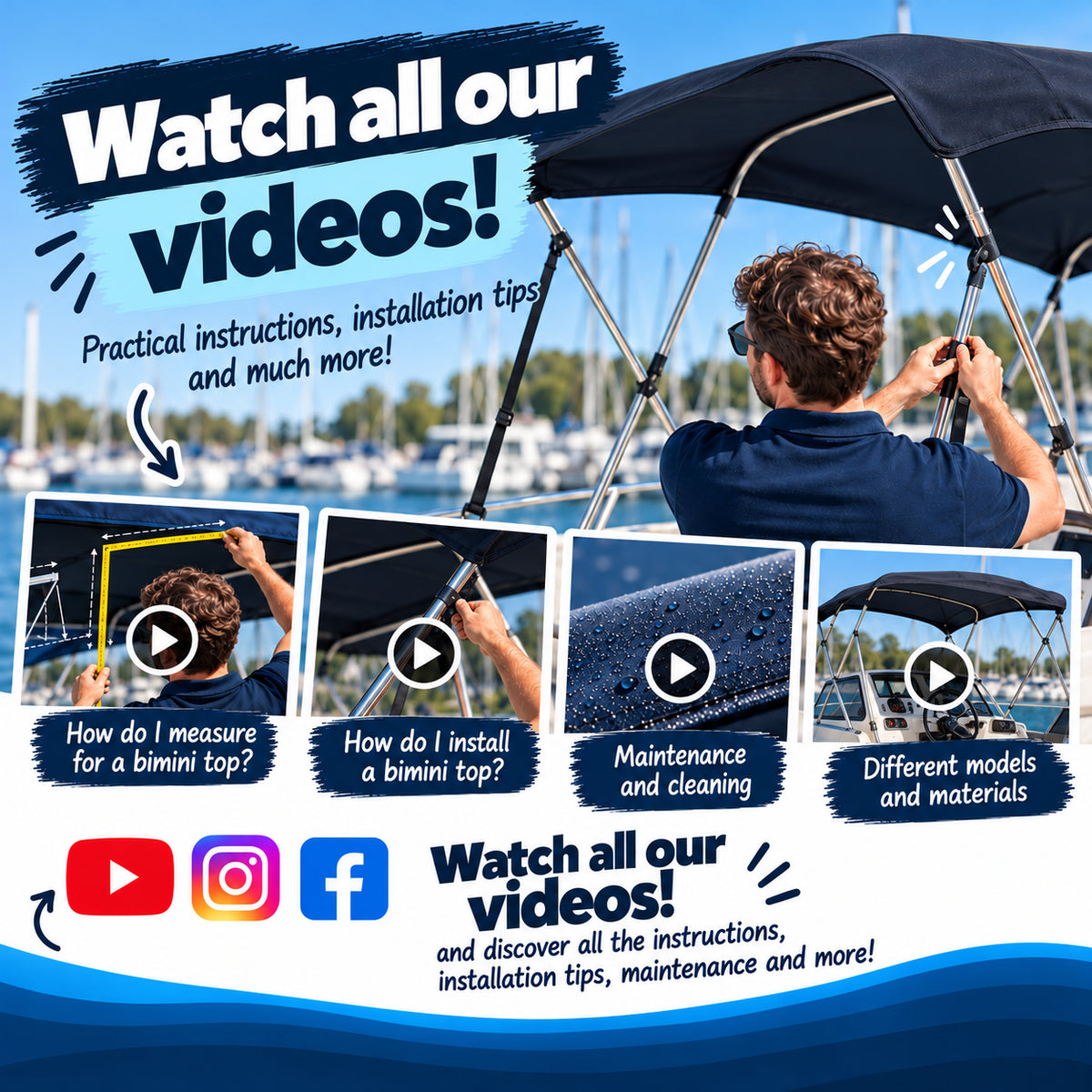
Measuring and installing your own bimini top?
With our handy instructional videos, we show you step-by-step how to determine the right size and easily install your bimini top.


The most affordable bimini tops in the Netherlands
Why is a bimini top important?
Why is a bimini top important?
A bimini top is a sturdy, foldable canopy that you mount on your boat to provide shade and protection from the elements. The frame, usually made of stainless steel or aluminum, ensures stability, while the fabric offers protection against the sun and light rain.
Why is a bimini top important?
Protection from the sun – The bright sun can be quite intense on the water. A bimini top helps reduce harmful UV radiation so you don't get sunburned and can enjoy your time for longer.
Comfortable boating – Without shade, your boat's deck can quickly become hot, making sitting and walking uncomfortable.
Extends the life of your boat interior – Prolonged exposure to sunlight can cause cushions and upholstery to fade or become damaged.
Shade without being enclosed – Unlike a cabin, a bimini top provides shade while maintaining an open and spacious feeling.
Bimini tops come in various designs, depending on your needs:
Stainless steel bimini tops – Extra strong and durable, ideal for larger boats.
Aluminum bimini tops – Lighter in weight, easy to install, and more affordable.
Inflatable bimini tops – Easy to store and ideal for those seeking flexibility.
At biminitopkopen.nl, we help you choose the right bimini top to suit your boat and boating style.
Which bimini top fits my boat?
Which bimini top fits my boat?
Choosing the right bimini top starts with carefully measuring your boat. This is a step you should not skip, as the wrong size can lead to poor installation, insufficient shade, or even damage to your boat. Naturally, you want to avoid that. To find the perfect bimini top, you need to consider three essential dimensions: width, height, and length.
Width of the mounting points
The width of your bimini top is not the same as the width of your boat.
Measure the distance between the mounting points on the boat. This determines the correct width size for the bimini top.
Most bimini tops have an adjustable width, with about 20 cm of leeway, giving you some flexibility during installation.
Ensure that the mounting points are sturdy enough to support the weight of the bimini top, especially in windy conditions.
Height of the bimini top
The height of the bimini top determines how much headroom you have under the canopy.
Standing helm position: Ensure you have enough space to stand upright without hitting your head.
Seated use: A lower bimini top can provide more shade, but it must be high enough to move around comfortably.
Keep storage space in mind: when you fold the bimini top down, it must fit in with other structures on the boat.
Length of the bimini top
The length determines the amount of shade and protection you receive.
Longer bimini tops offer more coverage but take up more space when folded.
Check that the folded version of the bimini top does not block other parts of the boat.
Choose a length that suits your sailing style: shorter tops are useful for boats with limited space, while longer tops are ideal for larger boats or longer trips.
Do you need help choosing the right bimini top? At biminitopkopen.nl, we are happy to assist you with personal advice and practical tips.
How do I install a bimini top?
How do I install a bimini top?
Fortunately, installing a bimini top is not a complicated job, provided you follow the right steps. Correct installation ensures that the bimini top remains sturdy and functions optimally. Follow this detailed guide to mount your bimini top professionally.
Step 1: Determine the mounting points
Choose the location where you want to mount the bimini top, taking balance and ease of use into account.
Measure the distance between the brackets and mark the mounting points on the boat.
Ensure that the bimini top does not get in the way when steering or boarding.
Check that there are no obstacles that could hinder the installation.
Step 2: Attach the mounting brackets
Drill the holes at the marked locations using the correct drill bit size.
Use stainless steel screws to prevent corrosion.
Screw the brackets firmly into place using the supplied mounting hardware.
Use a sealant to prevent water from seeping into the boat through the screw holes.
Step 3: Assemble the frame and stretch the fabric
Place the frame tubes into the mounting brackets and secure them.
Check that the structure is sturdy before stretching the fabric over it.
Pull the fabric taut over the frame and secure it with the mounting clips or straps.
Check that all parts are correctly in place and do not shift while sailing.
Step 4: Check and test stability
Fold and unfold the bimini top a few times to see if everything works smoothly.
Check whether the fabric is properly tensioned and does not move too much in the wind.
Put the boat in the water and test whether the bimini top remains stable at different speeds.
Don't feel like doing it yourself? Our installation service will gladly take it off your hands!
Is a bimini top waterproof?
Is a bimini top waterproof?
A bimini top is water-repellent, but not completely waterproof. This means that a light rain shower is usually not a problem, but water may seep through during prolonged rainfall.
How do you ensure your bimini top stays dry for longer?
Impregnate the fabric with a water-repellent spray to improve water resistance. Repeat this process at least once a season for optimal protection.
Tighten the fabric so that no puddles of water remain on it, which can cause leakage.
Always let the bimini top dry thoroughly before folding it up to prevent mold growth. Mold can weaken the fabric and significantly shorten its lifespan.
Use a bimini top cover to protect the fabric from weather elements, dirt, and UV radiation when not in use. This prevents premature wear.
Check the seams and zippers regularly and treat them with a special sealer to minimize water seepage.
Take the position of the boat into account when it rains. A slight incline can ensure that water runs off more easily and does not pool on the fabric.
Avoid prolonged exposure to heavy rainfall and stormy weather. In extreme cases, it is better to temporarily remove and store the bimini top.
By following these steps, you will extend the lifespan of your bimini top and prevent water damage. Do you want extra protection? At biminitopkopen.nl, we offer specialized water-repellent treatments and covers to keep your bimini top in top condition.
How do I maintain my bimini top?
How do I maintain my bimini top?
Proper maintenance ensures that your bimini top will last for years. Here are the best tips to keep your bimini top in top condition.
Cleaning and protection
Use a soft brush and a mild detergent to remove dirt and salt deposits.
Rinse the frame regularly with fresh water to prevent rust formation.
Do not use harsh cleaning agents, as these can damage the water-repellent layer.
Inspection and repair
Check the attachment points regularly for wear or loose screws.
Replace worn fabric in time to prevent it from tearing while sailing.
Check the elastic bands and tension straps and replace them if necessary.
Winter storage
Remove the bimini top from the boat if you are not using it during the winter.
Store the fabric in a dry place to prevent mold growth.
Grease the hinges and metal parts to avoid rust.
Which materials are used for bimini tops?
Which materials are used for bimini tops?
The material of your bimini top determines not only how long it will last, but also how well it performs in various weather conditions. There are three commonly used fabrics for bimini tops, each with its own characteristics and benefits.
Polyester fabric
Polyester is a popular choice due to its lightweight nature and quick drying time. This makes it ideal for boat owners who do not keep their bimini top up constantly but want to use it occasionally. Because polyester is less thick than some other materials, it is slightly less resistant to prolonged exposure to sun and salt water. Nevertheless, it is a great option for occasional use and for those looking for an affordable, functional solution.
Acrylic fabric (such as Sunbrella)
Acrylic is one of the best materials if you want a durable bimini top that lasts a long time. This material is UV-resistant, colorfast, and water-repellent. The best-known manufacturer is Sunbrella, which produces fabrics specifically designed not to fade or deteriorate quickly from sunlight and salt water. Acrylic is slightly thicker than polyester, making it better at withstanding extreme weather conditions and allowing it to last longer.
PVC-coated fabric
Do you want a bimini top that can really take a beating? Then a PVC-coated fabric is an interesting choice. This material is completely waterproof and extra sturdy, making it highly resistant to rain and wind. The disadvantage is that it is less breathable than acrylic or polyester, making it harder for heat to escape. In a tropical climate, it can therefore sometimes feel a bit stifling under the bimini top.
In addition to the fabric, the frame is also important. Bimini tops usually come with one of the following frame options:
Aluminum
Aluminum is a popular choice because it is lightweight and rust-resistant. This makes it easy to install and ideal for smaller boats or for people who frequently fold and unfold the bimini top. The only downside? Aluminum is less strong than stainless steel and can bend more easily in heavy winds or under intensive use.
Stainless steel
Stainless steel is the best choice if you are aiming for maximum strength and durability. This material is heavier than aluminum, but it can take a beating and is ideal for rough water conditions or larger boats. A stainless steel frame is often more expensive, but it lasts for many years longer without much maintenance.
Which combination suits you best depends on how often you use the bimini top, the conditions in which you sail, and how much you want to invest.
How do I choose the right color for my bimini top?
How do I choose the right color for my bimini top?
You don't just buy a bimini top for its practical benefits, of course – it also needs to look good on your boat. But did you know that the choice of color goes beyond just aesthetics? The color of your bimini top affects heat, maintenance, and how long it keeps that brand-new look.
Dark colors (black, navy blue, anthracite)
Dark colors absorb more heat, which means it can get a bit warmer under the bimini top. On the other hand, they show stains less easily and are less susceptible to fading from the sun. This is a major advantage, especially for those sailing in sunny regions.
Light colors (white, beige, light gray)
Lighter colors reflect more sunlight, keeping it cooler under the bimini top. This makes them a great choice for those who sail frequently in warm regions. The downside? They get dirty more quickly and show stains and discoloration sooner. Regular cleaning is therefore a must.
Neutral tones (gray, taupe, sand)
Neutral tones are the perfect middle ground. They don't absorb as much heat as dark colors, but they look good for longer than light shades. Moreover, they suit almost any boat, which is useful if you want a stylish and timeless look.
The choice of color therefore depends on where you sail, how often you clean, and what look you prefer. Many bimini tops are available in various colors, so you can always find a shade that suits your boat.
Can I sail with the bimini top extended?
Can I sail with the bimini top extended?
Yes, that is possible! However, there are a few important things to keep in mind. A bimini top is designed to provide shade and protection while boating, but not all bimini tops can withstand high speeds and strong winds.
At low speeds (up to 30 km/h)
On calm water and at low speeds, it is usually not a problem to keep your bimini top extended. This is ideal for leisurely trips, such as a day of fishing or cruising along the coast.
At higher speeds (above 30 km/h)
The faster you go, the more wind pressure is exerted on the bimini top. This can cause the frame to vibrate or even bend if the construction is not sturdy enough. Always check the manual for your bimini top to see what the maximum recommended speed is.
Wind and waves
The weather plays a major role in how stable a bimini top remains. In strong winds or rough waves, it is wise to fold down the bimini top. Otherwise, you run the risk of it flapping, the frame getting damaged, or – in the worst case – the bimini top breaking off.
Tips for safe boating with a bimini top
- Always use the straps to keep the fabric taut.
- Make sure the screws and attachment points are secure before you head out.
- Regularly check that the frame is still stable, especially after longer trips.
- Do you have a collapsible bimini top? Consider folding it halfway at higher speeds.
Do you want to boat without worry, even at higher speeds? Then look for a bimini top with an extra sturdy stainless steel frame and an aerodynamic design, specifically made for sports boats.
How do I store a bimini top when I'm not using it?
How do I store a bimini top when I'm not using it?
A bimini top can last for years, but only if you maintain it properly and store it the right way. When you're not using it, you want to prevent it from getting dirty, discolored, or damaged. Here are the best tips to keep your bimini top in top condition:
Always let it dry thoroughly
Before you fold up or store your bimini top, make sure it is completely dry. Moisture can cause mold and unpleasant odors, especially if the bimini top remains stored for a while.
Use a storage boot
A storage boot prevents dust, dirt, and UV radiation from damaging the fabric and the frame. This significantly extends its lifespan, especially if you leave your boat outdoors.
Fold and secure
Make sure your bimini top is securely folded and fastened with a storage strap. This prevents it from coming loose during transport or in strong winds.
Winter storage
Not using the boat in winter? Remove the bimini top entirely and store it in a dry, frost-free place. This prevents the material from drying out or becoming brittle due to cold and moisture.
With these simple steps, your bimini top will stay looking good and functional for longer, so you can enjoy it to the fullest every sailing season!
What is the difference between a 2-bow, 3-bow, and 4-bow bimini top?
What is the difference between a 2-bow, 3-bow, and 4-bow bimini top?
If you are looking for a bimini top, you will often see terms like 2-bow, 3-bow, or 4-bow. But what does that actually mean?
2-bow bimini top
This is the simplest version with two bows in the frame. It is compact and ideal for small boats such as sloops, console boats, and inflatables. The shade you get is somewhat limited, but it is a lightweight and affordable option.
3-bow bimini top
This is the most popular option for medium-sized boats. With three bows, you have a good balance between sturdiness and flexibility. It offers wider shade and remains stable, even at higher speeds.
4-bow bimini top
Do you have a larger boat or want maximum protection? Then a 4-bow bimini top is the best choice. This model is extra sturdy, covers a larger surface area, and is ideal for longer trips. The frame is more robust and offers better protection against wind and rain.
In short: the more bows, the more stable and larger the bimini top. But an extra bow also means more weight and sometimes a slightly higher price.
Can I install a bimini top myself or do I need a professional?
Can I install a bimini top myself or do I need a professional?
The good news: installing a bimini top is usually not rocket science. With a little patience and the right tools, you can easily do it yourself. However, whether you want to do it yourself or outsource it depends on a few factors.
Installing it yourself: what should you pay attention to?
Most bimini tops come with a clear manual and all the necessary mounting parts. But there are a few things you need to keep in mind:
You must measure accurately
The biggest mistake people make is not measuring the mounting points correctly. The width of your bimini top must match the distance between the mounting points on your boat. Always measure this twice to be sure you order the right size.
Brackets and screws must be fastened securely
A loose mount is a disaster on the water. Use stainless steel screws and ensure the mounting points are sturdy enough to handle the load.
Use sealant
Are you drilling holes in the boat? Then use a waterproof sealant around the screws to prevent leakage.
When is hiring a professional a good idea?
Some situations make it wise to outsource the installation:
You have a large boat with a complex structure.
You have no experience with drilling and assembly.
You want to be sure that everything is attached perfectly and is watertight.
At biminitopkopen.nl, as the leading bimini top specialist in the Netherlands, we go the extra mile. That is why we also offer an installation service. This way, you can be sure that your bimini top is installed securely and professionally by one of our experts. Contact us to discuss the options.
